Posted on

The Vernacular of Compassion

Bryant Johnson at Work
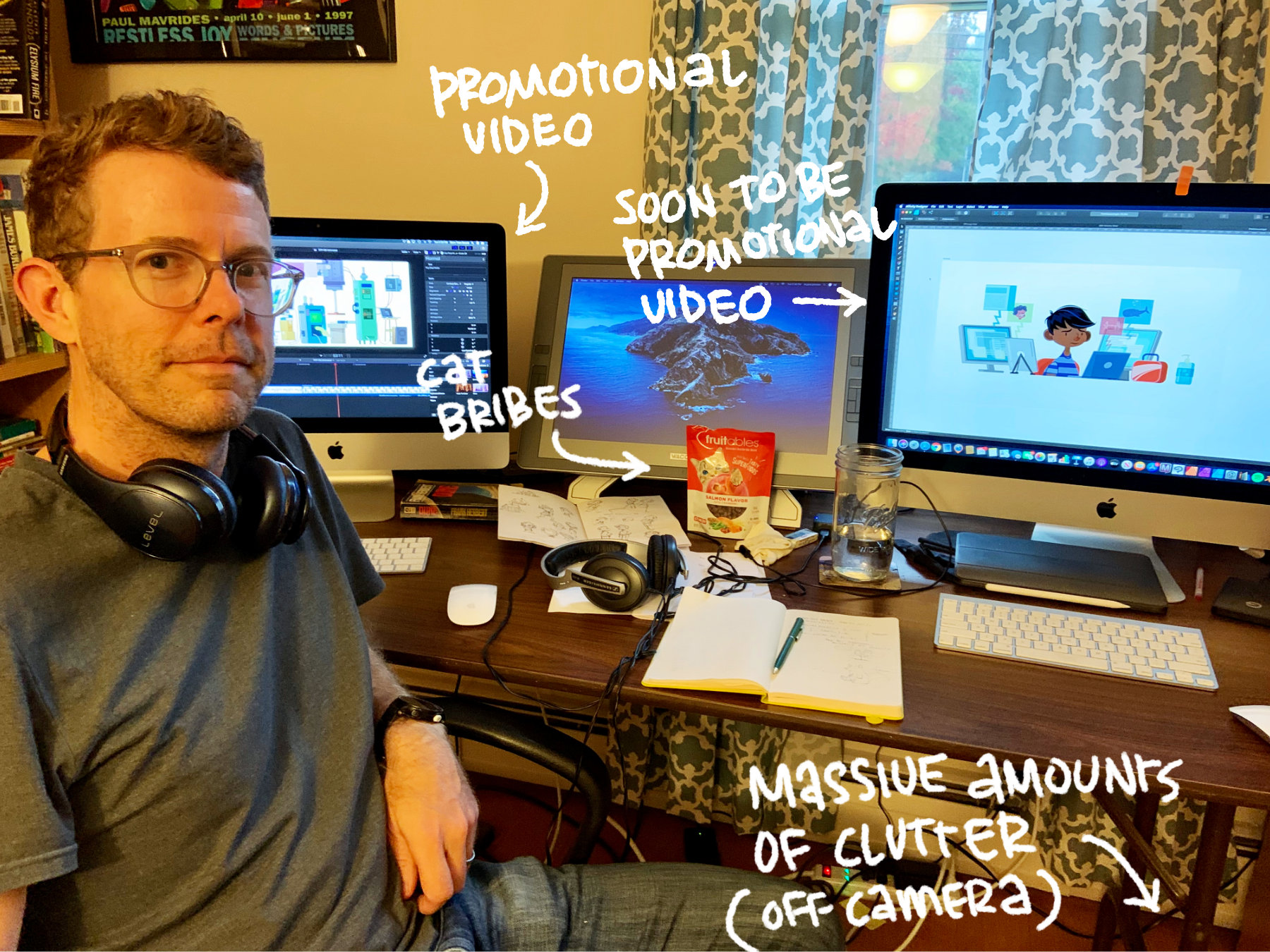
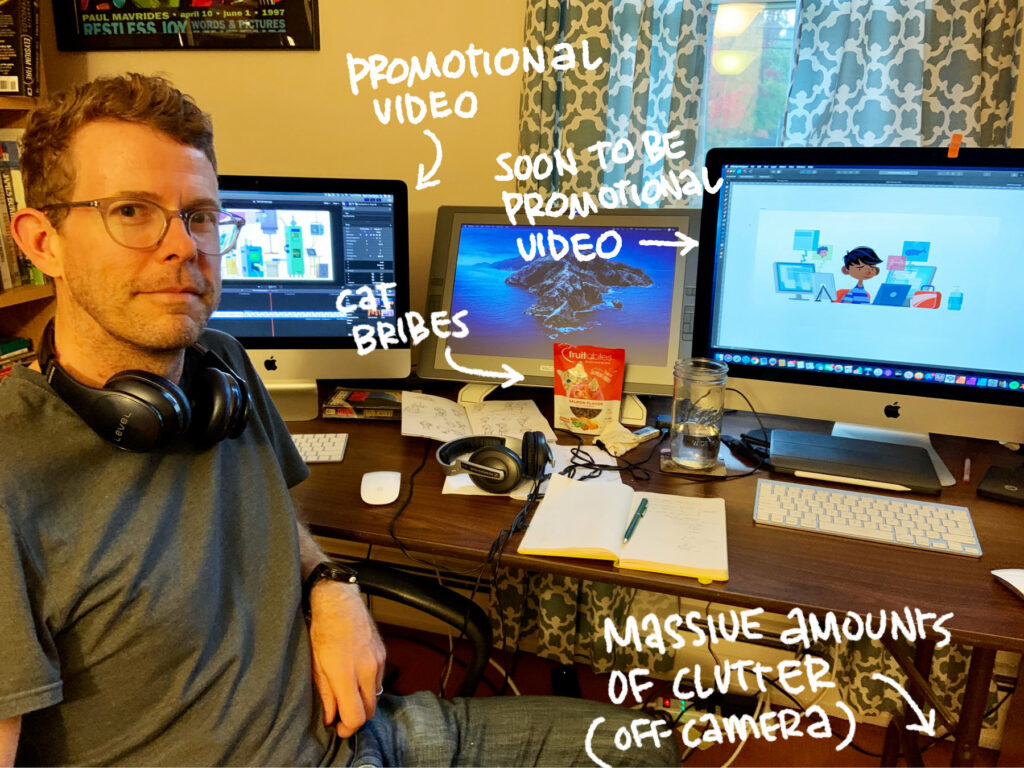
The author at his desk

As I type this (well, not literally), Iโ€™m putting the finishing touches on a promotional video for First Person Plural: EI & Beyond, a new podcast from Key Step Media. While my brain is awash in keyframes, masking layers, and animated warp deformations, I thought Iโ€™d take a moment to introduce myself, and my role in bringing you First Person Plural.

My name is Bryant Johnson. Iโ€™m a graphic designer, illustrator, and lately, an associate producer on First Person Plural. Iโ€™ve been working with Key Step Media (nรฉ More Than Sound) for seven years, designing the visual look for books, videos, pamphlets, and online trainings.

This spring, as I hunkered down in the pandemic bunker with my partner, my cats, and more streaming video than one could reasonably expect to consume in a lifetime (actually, I should have written โ€œmore booksโ€โ€”pretend I typed that instead), Hanuman reached out to me with the idea of creating a podcast on emotional intelligence with his father Daniel Goleman. He wanted to do a more freeform exploration of the subject, emphasizing lived human experiences. And, he asked if Iโ€™d be interested in working on it.

Of course I said yes.

Audio isnโ€™t exactly my mediumโ€”Iโ€™ve spent most of my life working in visual media: first in print, then video and board games, and later graphic design. But the subject is one I hold dearly.

Emotional intelligence is the reconciliation between the inner world of our thoughts, emotions, hopes, fears, and biases, with the external world of our interaction with others, and the systems we all navigate.

Itโ€™s a vocabulary to describe the dynamics weโ€™ve observed and experienced for our entire lives, but didnโ€™t know how to express. And when everything feels like itโ€™s on fire, itโ€™s a bucket of cool water within grabbing distance.

In the weeks since I first wrote this, much has changed in the world. We will have the opportunity to work towards a future without hate; without fear; without a cynical and mortally willful ignorance of reality.

What excites me is the chance to combine my experience in visual storytelling with a new [to me] medium: to craft new ways to make the material accessible, educational, and fun. To build an equitable future, we need more compassion. I hope that First Person Plural will make that abundantly clear, and give listeners a chance to build the skills of emotional intelligenceโ€”the vernacular of compassionโ€”in themselves.

We have some exciting episodes in production, and I canโ€™t wait to have you all join us in this endeavor!

Posted on

Emotional Intelligence in Times of Political Crisis

Leer en espaรฑol

I was born in Puerto Cabello, an idyllic seaside city in beautiful Venezuela. I am the daughter of Portuguese immigrants, who like so many others, came from Europe to build a better future in a rapidly developing and modernizing country.

Venezuela received my beloved parents with warmth and joy and a willingness to share prosperity with people who work hard and wanted to become one with their adopted country. My family found their longed for future, and although we were not millionaires, we never missed anything.

Human connection in Venezuela is very close, and it was always easy to find any excuse to meet with friends to celebrate, watch a game or movie together, or simply just enjoy life.

Today, the reality for an immense majority in Venezuela is quite different. Our promising Venezuela crumbled; things we once took for granted are no more. Even basic foodstuffs are scarce, and our citizens are forced to look for them in the trash, taking turns to scavenge for scraps to share.

The streets have lost joy, fear has taken its place, and insecurity has grown by leaps and bounds. Corruption of our political classes is sweeping, and conscious or not, it causes disparity and alienation. Only those who have the resources to pay someone for a passport can dream of a different destiny; maybe a destiny like my parents dreamed of when they left Europe all those years ago.

Those who still find reason to remain in Venezuela, or simply do not have the resources to leave, have accepted that we have water only at unforeseen times, unstable electricity and internet service (when we have it at all), and a diet dependent upon what is available. We receive with certain normalcy the news of a loved one murdered at the hand of an offender (in uniform or not).

Despite the beauty of our landscape and its abundant natural resources, we live in this situation today. This collapse of civilization as I knew and I experienced it caused me to reflect on how my training in Emotional Intelligence might help me and my family through these dark and dangerous days.

In my experience, having Emotional Intelligence made the difference between barely surviving and living courageously during the recent shutdown in Venezuela.

How can Emotional Intelligence be useful when our basic needs are at stake?

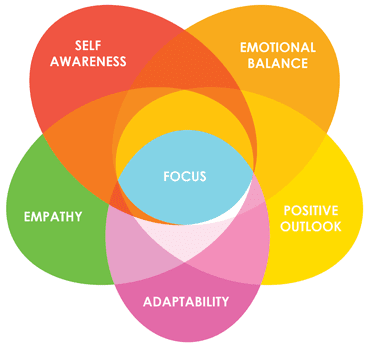
Emotional Self-Awareness

The first thing is to be aware of are your emotions.

For a few minutes every morning and every night I practiced meditation to calm my breathing. During the day, I consciously made the decision to listen to my body and to associate its changes with my emotions. That gave me the opportunity to intervene before my emotions escalated. When my heartbeat accelerated and I felt a certain knot in my chest and throat, I became aware of the presence of fear or anguish, which accompanied me during those days.

I made an effort to identify the trigger of those emotions and reactions in my body. I realized the triggers occurred when I mentally reviewed my plan to face the day without water, without electricity, with uncooked food, and with limited options to acquire basic necessities. During this time the throbbing in my chest was accompanied by the chaos of my thoughts, which gave rise to anguish and fear. Becoming aware of my trigger allowed me to exercise greater control over my reactions while planning my day.

Emotional Balance

Once I utilized emotional self-awareness, which is the foundation of Daniel Goleman’s Emotional Intelligence (EI) model, I took advantage of the skills related to the management of my emotions. Emotional balance helped me check my emotions and my reactions to them. This was particularly useful to me, because despite so much pressure, I was able to maintain my own emotional balance and help my family do so as well. I shared with them the importance of observing ourselves during those difficult days, and anticipating the inevitable negative emotions in order to keep ourselves upright. Emotional balance meant that we could pause at the first signs of anguish, fear, or anger, and intervene with a question, a smile, a moment of calm, a talk, and a prayer.

Adaptability

Adaptability enabled me to adjust to our daily struggle and keep my family afloat. Without this competence I would have been unable to recognize that I have the internal resources to deal with these daily challenges.

I try to remember that the conditions are temporarily different, and look for ways to minimize the impact of the whole situation. This allowed me to take off my heels and executive hat and collect water, look for charcoal or firewood, reorganize the housework, and re-plan significant activities.

My intention was not to adapt to being without electricity forever. Adaptability is not conformism; this ability allowed me to adjust to the situation, awakening the possibility to learn from it.

Positive Outlook

In the less stressful moments, I took advantage of positive outlook. In particular, I used a visualization micro-technique which I repeated whenever I considered it necessary. Very intentionally, I focused on the situation I wanted to be in; I imagined it, I gave it color and feeling. I knew that my brain would not know whether this was imaginary or real. This sense of focus gave me more time to talk with my daughters, to sit around a candlelit table game, and pick up books I had begun reading.

Achievement Orientation

I also put together a plan to stick to my current goals. I found a way to charge my phone, and in the moments in which I had telephone service, to update my learning team about my situation, schedule meetings, and anticipate alternatives in case the situation was repeated or extended.

I know that I am fortunate and in a privileged situation. While I focus on my certification, others made use of these skills to find medicine and medical care, or just feed their families and stay hydrated.

Empathy

And among these foundational competencies of Emotional Intelligence, the one that most comforted me and gave me the opportunity to help others was empathy.

By listening without interrupting, without judging, and without anticipating their answers, I was better able to understand what my daughters were thinking and feeling. Empathy allowed me to stay connected and compassionate amid the difficult situation.

Despite competition for basic resources, many of us shared food, water, a generator to charge some appliances, and kitchens at the homes of those who had gas stoves. We also understood that negative reactions often werenโ€™t personal; they were reactions to the whole situation. This understanding in a crisis situation is borne of walking in the shoes of the other and from having the tolerance to be compassionate. In my experience, none of that is possible without empathy.

EI Competencies in Practice

Hereโ€™s how you can translate these Emotional Intelligence competencies into concrete actions during a situation like the one we continue to live in Venezuela:

  • Develop awareness of your emotions. When you feel fear, anger, happiness, love or another emotion, recognize it. Then stop a moment and ask yourself how you feel, where you feel, and how it manifests in your body. Recognizing your emotions is essential to a strong foundation of Emotional Intelligence.
  • Take a break, ideally at the beginning of the day, to practice meditation or an activity that calms you. If youโ€™re new to meditation, try taking at least ten deep and slow breaths.
  • Become aware of how you react to each emotion and what your trigger is. For example, if you think about the dayโ€™s uncertainties and notice that your breathing starts to accelerate, stop; you just found a trigger. Prepare for how youโ€™ll react the next time you detect that trigger.
  • When you detect a strong emotion, donโ€™t react immediately. By taking time to pause, the response to your emotion will be a reaction from your brainโ€™s neocortex, which can override emotional reactions, and not your amygdala, which is automatic and often irrational.
  • Adapt to the new conditions. This will allow you the calm needed to build develop a plan. Visualize yourself achieving your plan; your brain will not make distinctions between this happening in reality or in your imagination, take advantage of it.
  • When you incorporate new routines, remember to treat yourself with kindness, calculate risks, and allow yourself the time to adjust to the new routine.
  • Remember that this situation does not define your lifeโ€“turn this into a mantra and do not give more power to the situation.
  • Practice tolerance and compassion. If you have knowledge of Emotional Intelligence, put it at the service of your connection with others, and lead your interactions with the harmony that only Emotional Intelligence can give us.

Above all, Emotional Intelligence is about recognizing our emotions in order to navigate them and effectively connect with others. EI is not about not feeling our emotions or repressing or controlling them, it is about managing our reactions to our emotions.

One day I found myself with tears in my eyes and I gave myself permission to mourn, to feel my fear, sadness, and anger. I cried for a while until I fell asleep, overcome by the fatigue of that day’s struggle. The next day it dawned on me; by remaining aware of my emotions and my reactions, I had the opportunity to help lead in an emotionally intelligent way, and share my story with my country and the world.

Posted on

Inteligencia Emocional en tiempos de Crisis Polรญtica

Read in English 

Nacรญ en Puerto Cabello, una idรญlica ciudad costera, en la bella Venezuela. Soy hija de inmigrantes portugueses, mis padres como tantos otros, vinieron de Europa para construir un mejor futuro en un paรญs en rรกpido crecimiento.

Venezuela recibiรณ a mis queridos padres con la templanza de sus paisajes, la calidez y alegrรญa de su gente y con toda su disposiciรณn a compartir su prosperidad con aquellos que con trabajo arduo decidieron ser parte de este, su paรญs adoptivo.

La conexiรณn humana en Venezuela es muy estrecha, y siempre fue fรกcil encontrar una excusa para reunirnos con amigos para celebrar, ver un juego o una pelรญcula juntos, o simplemente brindar por la vida.

Hoy en dรญa, la realidad para una inmensa mayorรญa en Venezuela es diferente. Nuestra prometedora Venezuela se derrumbรณ; las cosas que alguna vez dimos por sentadas ya no existen. Incluso los alimentos bรกsicos son escasos, y muchas personas se ven obligadas a buscarlos en la basura, tomando turnos para buscar restos que compartir.

Las calles han perdido alegrรญa, el miedo ha ocupado su lugar y la inseguridad ha crecido a pasos agigantados. La corrupciรณn de nuestras clases polรญticas es abismal, causando disparidad y alienaciรณn. Solo aquellos que tienen los recursos para pagarle a alguien por un pasaporte pueden soรฑar con un destino diferente; tal vez un destino como el que soรฑaron mis padres cuando salieron de Europa hace tantos aรฑos.

Quienes aรบn encuentran motivos para permanecer en Venezuela, o simplemente no tienen los recursos para irse, han aceptado tener agua algunos dรญas, electricidad e internet (cuando se tiene) inestable y una dieta que depende de lo que este disponible. Recibimos con cierta normalidad las noticias de un ser querido asesinado a manos de un delincuente (con uniforme o no).

A pesar de la belleza de nuestro paisaje y sus abundantes recursos naturales, hoy vivimos en esta crisis. Durante la reciente situaciรณn del apagรณn en Venezuela, me permitรญ reflexionar sobre como el conocimiento adquirido en mi entrenamiento en Inteligencia Emocional podrรญa ayudarnos a mรญ ya mi familia durante esos oscuros dรญas.

En mi experiencia, tener Inteligencia Emocional marcรณ la diferencia entre sobrevivir la experiencia y vivirla con propรณsito.

ยฟCรณmo puede ser รบtil la inteligencia emocional cuando nuestras necesidades bรกsicas estรกn en juego?

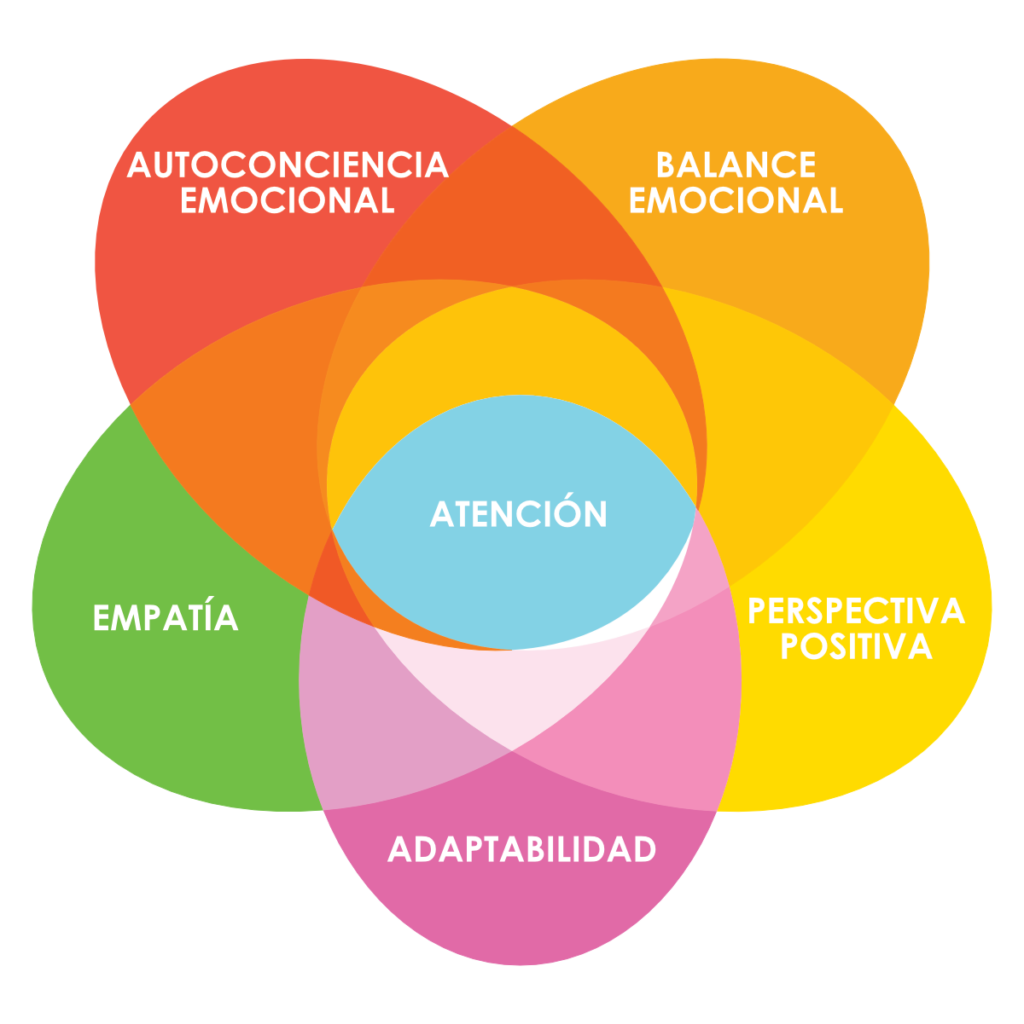
Autoconciencia emocional

Lo primero que debes tener en cuenta son tus emociones.

Por unos minutos cada maรฑana y todas las noches practiquรฉ meditaciรณn para calmar mi respiraciรณn. Durante el dรญa, tomรฉ conscientemente la decisiรณn de escuchar mi cuerpo y asociar sus cambios con mis emociones. Eso me diรณ la oportunidad de intervenir antes de que mis emociones aumentaran. Cuando los latidos de mi corazรณn se aceleraban y sentรญa un cierto nudo en el pecho y la garganta, sabia que estaba en presencia del miedo o la angustia, que me acompaรฑaron durante esos dรญas.

Hice un esfuerzo por identificar el desencadenante de esas emociones y reacciones en mi cuerpo. Me di cuenta de que los factores desencadenantes ocurrรญan cuando revisaba mentalmente mi plan para enfrentar el dรญa sin agua, sin electricidad, con alimentos sin refrigerar y con opciones limitadas para cubrir mis necesidades bรกsicas. Durante estos momentos, los latidos desordenados en mi pecho fueron acompaรฑados por el caos de mis pensamientos, que daban lugar a la angustia y el miedo. Tomar conciencia de mi desencadenante me permitiรณ luego, ejercer un mayor control sobre mis reacciones mientras planificaba mi dรญa.

Balance Emocional

Una vez que utilicรฉ la autoconciencia emocional, que es la base del modelo de Inteligencia Emocional (IE) de Daniel Goleman, aprovechรฉ las habilidades relacionadas con el manejo de mis emociones. El balance emocional me ayudรณ a gestionar mis emociones y controlar mis reacciones ante ellas. Esto fue particularmente รบtil para mรญ, porque a pesar de toda la presiรณn, pude mantener mi propio equilibrio emocional y ayudar a mi familia a hacerlo tambiรฉn. Compartรญ con ellos la importancia de observarnos durante esos dรญas difรญciles y anticipar las inevitables emociones negativas para no doblegarnos ante ellas. Esto nos permitiรณ poder detenernos ante los primeros signos de angustia, miedo o enojo, e intervenir con una pregunta, una sonrisa, un momento de calma, una conversaciรณn o una oraciรณn.

Adaptabilidad

La adaptabilidad me permitiรณ ajustarme a mi lucha diaria y mantener a mi familia a flote. Sin esta competencia, no habrรญa podido reconocer que tenia los recursos internos para enfrentar los desafรญos de esos dรญas.

Intencionalmente me hice consciente de la temporalidad de esta situaciรณn y busquรฉ formas de minimizar su impacto. Esto me permitiรณ quitarme los tacones y el sombrero ejecutivo y recolectar agua, buscar carbรณn o leรฑa, reorganizar las tareas domรฉsticas y replanificar actividades significativas.

Mi intenciรณn no era adaptarme a estar sin electricidad para siempre. La adaptabilidad no es conformismo; esta habilidad me permitiรณ ajustarme a la situaciรณn, despertando la posibilidad de aprender de ella.

Perspectiva Positiva

En los momentos menos estresantes, encontrรฉ un espacio para tomar ventaja de la competencia de perspectiva positiva. En particular, utilicรฉ una micro tรฉcnica de visualizaciรณn que repetรญ cada vez que lo considerรฉ necesario. Intencionalmente, me centrรฉ en la situaciรณn en la que querรญa estar; la imaginรฉ, le di color y sentimiento. Sabรญa que mi cerebro no harรญa diferencia entre si esto era imaginario o real.

Abrigada bajo esta competencia, encontrรฉ que el apagรณn tambiรฉn me dio mรกs tiempo para hablar con mis hijas, sentarme alrededor de un juego de mesa a la luz de las velas y retomar libros que habรญa comenzado a leer.

Orientaciรณn al logro

Tambiรฉn armรฉ un plan para mantener mis objetivos del momento. Por ejemplo, para cumplir con mi compromiso de aprendizaje para la Certificaciรณn de Entrenamiento en Inteligencia Emocional, encontrรฉ la forma de cargar mi telรฉfono de manera que en  los momentos en que tuve el servicio telefรณnico, pude informar a mi equipo de aprendizaje sobre mi situaciรณn, programar reuniones y anticipar alternativas, previniendo que la situaciรณn se extendiera en el tiempo

Sรฉ que soy afortunada y que estoy en una situaciรณn privilegiada. Mientras yo estaba enfocada en mi certificaciรณn, otros usaron estas habilidades para encontrar medicamentos y atenciรณn mรฉdica, o simplemente alimentar a sus familias y mantenerse hidratados.

Empatรญa

Y entre estas competencias fundamentales de la Inteligencia Emocional, la que mรกs me consolรณ y me dio la oportunidad de ayudar a los demรกs fue la empatรญa.

Al escuchar sin interrumpir, sin juzgar y sin anticipar sus respuestas, pude entender mejor lo que mis hijas estaban pensando y sintiendo. La empatรญa me permitiรณ estar conectada y ser compasiva en medio de la difรญcil situaciรณn.

A pesar de la necesidad de todos  por los recursos bรกsicos, muchos de nosotros compartimos alimentos, agua, un generador para cargar algunos electrodomรฉsticos y cocinas en las casas de las personas que tenรญan estufas de gas. Tambiรฉn entendimos que las reacciones negativas a menudo no eran personales; eran reacciones a toda la situaciรณn. Comprender esto, es solo posible cuando te pones en los zapatos del otro y cultivas la compasiรณn y la tolerancia. En mi experiencia, nada de eso es posible sin empatรญa. 

Competencias de la IE en la prรกctica

Aquรญ encontraras como puedes traducir estas competencias de Inteligencia Emocional en acciones concretas durante una situaciรณn como la que vivimos en Venezuela:

  • Desarrolla la conciencia de tus emociones. Cuando sientas miedo, ira, felicidad, amor u otra emociรณn, reconรณcela. Luego detente un momento y pregรบntate cรณmo se siente, dรณnde se siente y cรณmo se manifiesta en tu cuerpo. Reconocer tus emociones es esencial para contar con una base sรณlida de Inteligencia Emocional.
  • Tรณmate un descanso, idealmente al comienzo del dรญa, para practicar la meditaciรณn o una actividad que te calme. Si eres nuevo en la meditaciรณn, empieza haciendo al menos diez respiraciones profundas y lentas.
  • Toma conciencia de cรณmo reaccionas ante cada emociรณn y cuรกl es su desencadenante. Por ejemplo, si te levantas con la lista de todos tus pendientes y notas que u respiraciรณn comienza a acelerarse, detรฉnte; acabas de encontrar un disparador. Prepรกrate para la forma en que reaccionarรก la prรณxima vez que detectes ese disparador.
  • Cuando detectes una emociรณn fuerte, no reacciones de inmediato. Al tomarte el tiempo para hacer una pausa, la respuesta a tu emociรณn serรก una reacciรณn del neocortex de tu cerebro, que puede anular las reacciones emocionales, y no de tu amรญgdala, que es automรกtica y, a menudo, irracional.
  • Adรกptate a las nuevas condiciones. Esto te permitirรก la calma necesaria para construir un plan. Visualรญzate logrando tu plan; tu cerebro no harรก distinciones entre si el logro de tu plan sucede en la realidad o en tu imaginaciรณn, aprovรฉchalo.
  • Cuando incorpores nuevas rutinas, recuerda tratarte con amabilidad, calcula los riesgos y tรณmete el tiempo para adaptarte.
  • Recuerda que esta situaciรณn no define tu vida; convierte esto en un mantra y no le otorgues mรกs poder a la situaciรณn.
  • Practica la tolerancia y la compasiรณn. Si tienes conocimiento de Inteligencia Emocional, ponlo al servicio de tu conexiรณn con los demรกs y gestiona tus interacciones con la armonรญa que solo la Inteligencia Emocional puede brindarnos.

Por encima de todo, la Inteligencia Emocional consiste en reconocer nuestras emociones para navegarlas y conectarnos efectivamente con los demรกs. La IE no se trata de no sentir nuestras emociones ni de reprimirlas o controlarlas, se trata de controlar nuestras reacciones ante nuestras emociones.

En mi caso, una madrugada me encontrรฉ con mis lagrimas y me di el permiso de llorar, de sentir mi quiebre tejido de miedo, tristeza y rabia, llorรฉ un rato hasta quedarme dormida vencida por el cansancio de la lucha de ese dรญa.. y luego amaneciรณ. Y consciente de mi emociรณn y de mi reacciรณn, ese amanecer tambiรฉn me diรณ la oportunidad de elegir conducirme de manera emocionalmente inteligente, dejando mi granito de arena a mi paรญs  y al mundo.

Posted on

Stories that Change the Status Quo

The stories we tell, the words we choose, and the body language that accompanies those words have a tremendous impact on our ability to influence others. When people feel understood and can see themselves within the story you tell, you gain the power to change the status quo.

Influence is the essence of what a leader does. As such, you can utilize influence to gain buy-in for your ideas, to foster change in your organization, and to instill purpose in your work, even if you arenโ€™t in a formal leadership position.

On a neurological level, tone of voice, body movements, gestures, facial expression, and posture all combine to create packages of energy received by the social brain. People with strengths in influence are sensitive to the exchange of this energy and use it to persuade through language.

Storytelling enables us to connect with the social brain. This active engagement fosters trust and resonance with others. After all, a compelling story is far more engaging than facts or information alone. We can use stories as vehicles for information that also speak to our shared emotions and goals.

Telling Your Story

Leadersโ€“whether formal or informalโ€“achieve their effectiveness through the stories they tell. Resonant narratives offer an alternative to the prevailing storyline (โ€œthis is just the way things areโ€) and help us gain buy-in from others to move an idea or project forward.

Marshall Ganz, community organizer and Harvard professor, has identified three layers to an effective public story: โ€œthe story of self, the story of us, and the story of now.โ€ The story of self is your personal story. This includes why you have chosen to pursue changeโ€“whether you want to make your company more environmentally sustainable, improve the school system in which you teach, or establish patient limits in your hospital.

Why is this change important to you? And how has your story thus far led you to value this change? You might begin by thinking about your parents and your childhood. In what ways has your past led you to where you are today?

The story of us enables others to fit themselves into your vision. What values do you and members of your organization share? What story can you tell that articulates your shared identity? For example, as a nurse petitioning for safe patient limits, you might find the story of us in a common desire to help others, for which you and your coworkers have made sacrifices throughout your careers.

An effective story of us necessitates authentic leadership. With self-awareness and empathy, we can build genuine rapport with those we seek to lead. Without these competencies, the group you want to influence may find it difficult to relate to you or envision themselves within your narrative.

Lastly, the story of now articulates the action you and your group must take. Effective leaders identify actions, not simply problems. What specific action will you call upon your group to take? How does this serve your mission? Why should your group take this action now, instead of postponing it for the future?

You may find it beneficial to tell your story to a friend or record yourself. Start at the beginning (your parents, your childhood), move toward the present, and envision the future youโ€™d like to shape.

Once youโ€™ve gotten your thoughts out, try to distill your answers to three sentences, one for each layer (self, us, and now) of your story. The ultimate goal of this exercise isnโ€™t to write a single narrative, but to have pieces you can adapt and iterate from again and again for different audiences and situations. When we build a narrative in this way, we develop the tools to initiate positive change in our communities and organizations.

This activity is inspired by Marshall Ganzโ€™s worksheet, โ€œTelling Your Public Story.โ€ If youโ€™re interested in developing a politically oriented story, you may find his work particularly beneficial.  

Posted on

Compassion Takes Guts

When we think about the word, โ€œcompassion,โ€ images of Mother Teresa and other angelic personas may come to mindโ€“images of figures who have sacrificed something, be it cozy comforts or their lives. Compassion is also sometimes misconstrued as being soft and squishy: people who are nice, affectionate, and sweet all the time.

In reality, compassion does not require us to throw ourselves in front of a truck to save someoneโ€™s life, or that we give up our hopes and dreams for another. It doesnโ€™t even require a national catastrophe for us to demonstrate compassion. Rather, we are faced daily with decision points that allow us to practice compassion on an individual level.

Compassion extends beyond feeling sorry for the suffering of others, and while itโ€™s grounded in empathy, it is actually not the same. Empathy is often characterized as feeling โ€œwith,โ€ whereas compassion fuels our desire to alleviate suffering. In this way, compassion is empathy combined with the impetus to act. In fact, different parts of our brain get activated by compassion than by empathy. Studies by neuroscientist Tania Singer, at the Max Planck Institute for Human Cognitive and Brain Sciences in Germany, show that when we practice empathy, our mirror neurons are in tune with the emotions of the other person: When that person feels pain, the area of our brain for pain also activates. We feel what they feel.

However, this doesnโ€™t always mean we act. In fact, we may become too paralyzed to help when we are struck by empathyโ€“so that we turn away from helping because what we feel is too painful. On the other hand, when we practice compassion, we activate the part of our brain associated with maternal and prosocial behavior; we are concerned and we become motivated to help.

So why are we sometimes moved to help, and other times not? Daniel Goleman references the famous study of Princeton Theological Seminary students to explain. Divinity students were given a sermon topic to practice. Some of them were given the Parable of the Good Samaritan. They were asked to walk to another building to deliver the sermon. During that walk they each encountered a man clearly in need. Some students stopped; others didnโ€™t. The researchers found that the gap didnโ€™t have to do with the sermon topic, but with how much of a hurry they were in. In other words, when they were rushed, they focused on their own needs. While practicing their sermons on being Good Samaritans, they forgot to be Good Samaritans.

This is the paradox, Goleman says, of living in the Anthropocene Age (the geological age in which one speciesโ€“humansโ€“impact every other species), while our brains were formed during the Pleistocene Age (Ice Age). During the Ice Age we were (and still often are) ruled by our amygdala, our brainโ€™s 9-1-1 alarm system. This part of the brain is oblivious to the impact of our individual, micro-actions on others.

Still, our brains are actually primed for compassion. It is in our nature to want to help. As Dr. Goleman points out, the minute we โ€œattend to the other person, we automatically empathize, we automatically feel with them.โ€ If we remain preoccupied with ourselves, however, we canโ€™t be present enough to even notice that someone else needs help, let alone get past our own personal pain to a point from which we can take action.

The good news is that compassion can be cultivated. The more Self-Aware we areโ€“the more attuned we become to what is happening internallyโ€“the better we can engage with the world beyond ourselves. The greater attention we pay to Self-Managementโ€“our ability to manage any emotional triggers or reactionsโ€“the better we can navigate these emotions in order to help others. The more we recognize our motivationโ€“what drives usโ€“the more we can stay true to our core values. Moreover, those who nurture the Relationship Management competencies of Emotional Intelligence, โ€œhave a genuine interest in helping people, especially those who could benefit from their experience.โ€

But itโ€™s not so easy.

Sure, we can picture ourselves as compassionate beings donating money to help a worthy cause 3,000 miles away. Yet when it comes to our own interactions, showing compassion may be a lot harder. Imagine you have witnessed inappropriate or off-color behaviors and comments from your boss and have noticed how that has created a toxic work environment. You recognize that there have been some ethical, if not legal, transgressions, but at the same time, you care about your teammates, your relationship with your boss, and your job security.

What might be a compassionate response?

LinkedInโ€™s Jeff Weiner, who has been at the forefront of promoting compassionate leadership, would suggest that a compassionate response is neither to let such behaviors slide nor to launch an all-out assault on the transgressor. Instead, compassionate responses require us to recognize our own triggers, try to put ourselves in the other personโ€™s shoes, and to have the courage to take a stand.

Perhaps your bossโ€™s inappropriate comments were borne out of insecurity or a complete lack of awareness. While that doesnโ€™t abdicate them of responsibility, putting ourselves in their shoes allows us to witness the situation without being swept away by our own emotional triggers. Doing so may also help us understand how the bossโ€™s actions impact the team. It also allows us to reflect on how our actions may be in service of a greater good. Are we confronting our boss or reporting them out of pettiness, or are we doing so in service of the team and for the bossโ€™s own professional growth and development?

As Thupten Jinpa, the Dalai Lamaโ€™s translator, noted, compassion requires a heck of a lot courage. It isnโ€™t about blind forgiveness, ignorance, or revenge, but about stepping into challenging situations in the service of something greater. In times of great uncertainty, whether at the global or local level, compassion is vital to the well-being of ourselves and others.


Posted on

How Sleep Primes The Brain For Emotional Intelligence

When I first started dating my now husband, he asked me what he should know about me. The first thing I told him was that if he notices that Iโ€™m ever a bit โ€œgrumpy,โ€ itโ€™s likely an easy fix. I realized after a decade of sleep deprivation raising my three kids, who are now teenagers, that I need eight hours of sleep.ย Little did I know, itโ€™s not just meโ€ฆwe all need our sleep. And, according to Matthew Walker, PhDโ€™s new book, Why We Sleep, Unlocking the Power of Sleep and Dreams, getting eight hours of sleep not only makes us feel great, but measurably improves our performance. Sleep is also key to building Emotional Intelligence. It can affect our Emotional Self-Control, Empathy, and Adaptability, which are three of the twelve competencies that Daniel Golemanโ€™s research has determined comprise Emotional Intelligence.

Getting eight hours of sleep is essentialโ€“not six or seven, but eight hours. Why? According to the research, those last two hours are filled with 60-90% of the important dream state REM (rapid eye movement) sleep. It is during this time that our brains get a sort of emotional tune-up. As humans, we have the ability to deeply experience and regulate our emotions. We can recognize and influence the emotions of others. We also have more REM sleep than any other species. According to Walker, REM sleep โ€œenhances emotional and social sophistication.โ€ ย 

Here are three ways that sleep helps build Emotional Intelligence:

1.ย ย Sleep helps us manage our emotions ย 

I described how I sometimes become โ€œgrumpyโ€ when I donโ€™t get enough sleep. Parents of young children experience this all the time. Both in the sleep deprived parent and in the toddler who was possibly up all through the night. We see it in the workplace when an โ€œangryโ€ leader might snap at and lose patience with a subordinate. A sleep deprived doctor can come across as impatient and have poor bedside manners. These โ€œinappropriate emotionsโ€ are often the result of sleep deprived individuals. This is not an effective way to build strong relationships and improve connections. Managing ourselves and having Emotional Self-Controlย (also referred to as Emotional Balance) is a key competency for building Emotional Intelligence. ย 

So how does sleep help us manage our emotions? A part of the brain called the amygdala is responsible for triggering strong emotions such and anger and rage, and is linked to our fight or flight response. Walker describes a sleep study in which two groups were shown images that ranged from neutral in content (a basket, a piece of driftwood) to negative in content (a burning house, a venomous snake) to a group of individuals who stayed up all night and another group who got a full night of sleep. It turns out, the sleep deprived individuals showed well over a 60% increase in emotional reactivity in the amygdala. The well rested group showed only a modest degree of reactivity.

Without adequate sleep, we produce inappropriate emotional reactions and are unable to put things and situations in the appropriate contexts. To make matters worse, the part of our brain that is responsible for managing the emotions of the amygdala is compromised by sleep deprivation. This area, called the prefrontal cortex, is responsible for rational, logical decision making. Getting adequate rest is essential to maintaining Emotional Balance.ย ย 

2.ย Sleep builds Empathyย ย 

Empathy is another important competency of Emotional Intelligence. Empathy means having the ability to sense other peopleโ€™s feelings and understand what they are experiencing and thinking. It means having an interest in what matters to the other person. Our ability to recognize different emotions through facial expressions is one way that we can develop Empathy. Facial expressions communicate the emotions and intent of another person. Our response can be influenced by the expressions of another. ย ย 

There are regions of the brain whose job is to read and decode the meaning of emotional signals, especially in faces. It is these regions of the brain that REM sleep recalibrates at night. Matthew Walker makes the analogy, โ€œwe can think of REM sleep like a master piano tuner, one that readjusts the brainโ€™s emotional instrumentation at night to pitch perfect precision, so that when you wake up the next morning, you can discern overt and subtly covert micro-expressions with exactitude.โ€ When we deprive ourselves of this dream state REM sleep, facial expressions become distorted. This is where we might confuse a friendly expression with anger or frustration. ย ย 

I remember meeting my friend, Charles, for coffee one early morning. I had a late dinner meeting the night before and I felt exhausted. Shortly into our conversation, I shared a thought about an idea we were brainstorming. I could see his mouth close tight. He looked up. And I could feel my heart start to race. I thought to myself, โ€œHere it comes.โ€ I could feel my body tighten as I prepared for the coming argument and possible harsh critique of what I had just said. Just as I was about to prematurely defend myself and my idea out loud, Charles broke into a smile, his eyes softened and he said, โ€œI agree.โ€

I had mistaken his โ€œthinkingโ€ look with what I thought was an โ€œangryโ€ look. What started off as a friendly conversation could have easily turned into a negative experience. Thankfully, I didnโ€™t react to my sleep deprived misinterpretation.

3. Sleep sparks creativity

Being able to handle change and adapt to new situations with fresh ideas or innovative approaches is another key competency in building Emotional Intelligence. ย 

How does this show up in the brain after a good night of sleep? Walker shows through several studies the increased creativity of his participants compared to the sleep deprived individuals. It is especially true after a full night of rich dream state REM sleep. One study showed problem solving abilities increased by 15-35%. A full night of dream-induced REM sleep also revealed an ease in problem solving. When we are in our dream state, our mind can process a wide range of stored information and come up with multiple solutions for complicated problems. ย 

In the workplace, a creative leader can adapt more easily to a changing environment. They can think of multiple ways to achieve their goals. They donโ€™t get stuck in the same old ways of doing things. They are open to new ideas and perspectives. And they are therefore able to grow and innovate. These are all important aspects of Emotional Intelligence. ย 

It is clear that getting eight hours of sleep, especially the dream state REM sleep, is essential to well-being, optimal performance at work, and building our Emotional Intelligence. So how do we actually get better sleep? Walker offers several ideas. Here are my top three favorites:

  • Exercise! But not within 2-3 hours of sleep.ย Exercise helps your brain and body to relax, but working out too close to bedtime can be counterproductive. Your body temperature can remain high after exercise, making it difficult to drop your core temperature sufficiently to initiate sleep.
  • Allow yourself adequate time to prepare for bed.ย Reading, using dim lights or candles, and listening to soft music are soothing activities to prime yourself for rest.ย ย 
  • Create a tidy, gadget-free bedroom environment that is conducive to sleep.ย Tidy up your bedroom and remove your gadgets so that distractions are minimized. Open the windows to cool down the room; this helps drop core body temperature which is also needed to initiate sleep.

For further reading, our series of primers focuses on the twelve Emotional and Social Intelligence Leadership Competencies, which include Emotional Self-Control, Adaptability, and Empathy.

The primers are written by Daniel Goleman and Richard Boyatzis, co-creators of the Emotional and Social Intelligence Leadershipย Competency Model, along with a range of colleagues, thought-leaders, researchers, and leaders with expertise in the various competencies. Explore the full list ofย primers by topic, or get theย complete collection!

Posted on

Give Negative Feedback with Empathy

Seth, the regional manager of an insurance agency, had a reputation for enforcing the rigid guidelines sent down from upper management, while doing the bare minimum himself. When one of his newest employees, Jason, failed to record customer information in accordance with guidelines, Seth arranged a meeting to set him straight. After talking Jasonโ€™s ear off about the importance of playing by the book, Seth handed him a few examples of correct customer reports and told him to study up or find work somewhere else.

Jason, who had never received detailed training on the customer reports, became instantly and thoroughly discouraged. While he still made an effort to get by, he felt increasingly apathetic about his job. He was not alone: Other members of the team felt the same disengagement. They avoided Seth and kept their heads down, trying to do their work without having to deal with him. No surprise that Sethโ€™s reputation for intractability also prevented people from sharing their ideas with him. Result: sales plummeted.

Last I heard, Seth had been replaced by a new regional manager, tasked with revitalizing a floundering business. Itโ€™s no surprise โ€“ Seth was not just difficult to work with, but an ineffective leader as well. Looked at through the emotional intelligence lens, what Seth lacked was empathic concern.

Empathic concern is one of three types of empathy. The first type, cognitive empathy, lets us understand othersโ€™ perspectives. The second, emotional empathy, allows us to experience othersโ€™ emotions in our own body, giving us an immediate sense of what they feel. And the third, empathic concern, moves us to action. We care about other peopleโ€™s well-being and feel motivated to help them. This is where empathy extends into compassion.

Consider results from a study of how empathic concern matters when we give negative feedback. Researchers found that leaders who gave negative feedback with empathetic concern got better responses from their employees, who also rated them as more effective. And this caused higher-ups to view these leaders as more promotable.

People respond more positively to criticism and are more likely to take feedback to heart when they feel their leader cares about their well-being and wants them to improve. Empathic concern makes feedback more effective, kickstarting positive change in employees and rippling throughout organizations.

Instead of grilling a new hire like Jason over an understandable mistake, Seth could have empathized with Jasonโ€™s need to learn how to perform his new job, and maybe also nodded to the tediousness of the task. Most important, he could have expressed his desire for Jason to succeed and offered to give him further guidance if needed. But by resorting to scripted lectures and unwarranted threats, Seth prevented a new employee from becoming engaged and motivated to do his best.

A leaderโ€™s emotional intelligence (or lack thereof) can make or break an employeeโ€™s performance for an organization. The benefits (or toll) can be seen in indicators like employee engagement, creativity, and turnover. EI โ€“ being intelligent about emotions โ€“ includes ways to manage our own emotions and help shape emotions in others. This includes the ability to give feedback effectively, to inspire and motivate, and to consider employeesโ€™ feelings when making decisions.

So, a lack of empathy in a manager or executive creates dissonance. Leaders who donโ€™t consider their employeesโ€™ perspectives when delivering feedback foster a tense environment in which trust and collaboration cannot flourish.

EI training can help leaders get better at the range of people skills they need, such as recognizing their employeesโ€™ emotional reactions and communicating their understanding and concern. By attuning ourselves to othersโ€™ emotions, performance feedback becomes an opportunity to create positive change and cultivate engagement. And when employees experience this positive resonance, leaders โ€“ and their organization โ€“ can gain a range of value-added benefits.

Recommended Reading:

For further reading, our series of primers focuses on the twelve Emotional and Social Intelligence Leadership Competencies, which include Emotional Self-Awareness, Empathy, and Coach and Mentor.

The primers are written by Daniel Goleman and Richard Boyatzis, co-creators of the Emotional and Social Intelligence Leadership Competency Model, along with a range of colleagues, thought-leaders, researchers, and leaders with expertise in the various competencies. Explore the full list ofย primers by topic, or get theย complete collection!

For more in-depth reading on leadership and EI,ย What Makes a Leader: Why Emotional Intelligence Mattersย presents Daniel Golemanโ€™s ground-breaking, highly sought-after articles from theย Harvard Business Reviewย and other business journals in one volume. It features more than half a dozen articles, including โ€œReawakening Your Passion for Work.โ€